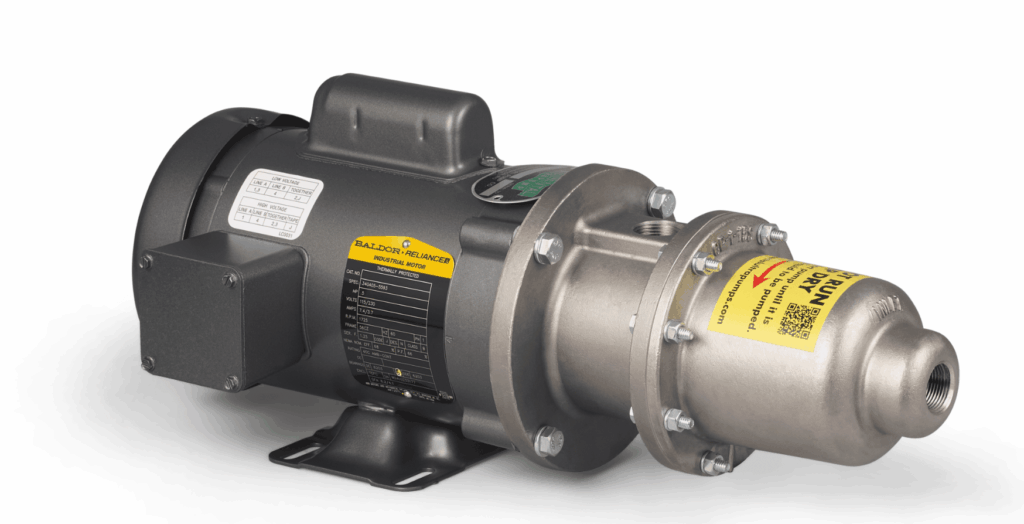
Progressive cavity pumps (PC pumps) are a type of positive displacement pump designed for handling fluids with varying viscosities, solids content, and flow conditions. Their versatility and ability to provide a smooth, non-pulsating flow make them ideal for a wide range of industrial applications, from wastewater treatment to food processing.
Unlike centrifugal pumps that impart kinetic energy to fluids, progressive cavity pumps move fluid by trapping it in cavities between a single-helix rotor and a double-helix stator. As the rotor turns, the fluid advances in a uniform, laminar motion. This design enables PC pumps to handle thick sludges, shear-sensitive materials, and even abrasive slurries with remarkable consistency. In this guide, we break down how progressive cavity pumps work, when to use them, and how they compare to other pump types.
How Do Progressive Cavity Pumps Work?
PC pumps consist of two main parts: a single-helix rotor and a double-helix stator. As the rotor turns within the stator, a sequence of cavities is formed that traps and transports fluid.
Operating Principles
Positive displacement: Fluid is moved through sealed cavities formed between the rotor and stator.
Constant flow rate: Independent of system pressure (within design limits), making them ideal for metering.
Low-shear motion: Perfect for shear-sensitive materials due to the smooth transfer action.
The rotor, often made of hardened alloy steel or stainless steel and coated with chrome plating, rotates inside the stator—an elastomeric tube molded from synthetic or natural rubber. These tightly sealed cavities form a continuous, self-priming suction that allows the pump to lift liquids up to 28 feet when installed appropriately.
Lubrication and Wear Considerations
The pumped fluid acts as the lubricant between the rotor and stator. If the pump runs dry (i.e., without fluid), rapid deterioration—especially of the stator—can occur. Abrasive fluids, while manageable, accelerate wear. To mitigate this, slower pump speeds (RPMs) are often used for slurries or gritty liquids.
Versatility in Application
Progressive cavity pumps can reliably handle fluids with entrained air, high solids content, or thick viscosities. Their reversible directionality also allows them to operate clockwise or counter-clockwise in many installations. Combined with flexible mounting options and compatibility with various motor types (pneumatic motors-hydraulic motors, etc), these pumps are adaptable to a wide range of system designs and constraints.
Progressive Cavity Pump Types
PC pumps are available in multiple series, each designed for specific operational challenges and fluid characteristics. Kinetiflo’s models are distinguished by their build, drive style, application focus, and materials of construction:
CP Series
Basic bare-shaft pump ideal for light-duty and intermittent operations.
CPM Series
Close-coupled design with a motor mounted directly to the pump, compact and efficient.
CPML Series
Enhanced CPM design with flexible drive arrangements, ideal for tighter flow control.
CL Series
Rigid stator configuration for general-purpose industrial use with long service life.
CM Series
Larger drive head for higher pressure capability; suitable for demanding industrial duty.
CJ Series
Hopper-style pump with a flighted auger, specifically designed for conveying high-viscosity pumpages.
CK 2000 Series
Heavy-duty design with crown gear joints, built to handle higher pressures and axial forces in rugged applications such as mining and oil sludge.
CG Series
Built with crown gear joint connections and suitable for rugged applications such as sewage, sludge, or slurries.
Continental PC pump models also offer flexibility in suction housing orientation (90° to 270°), and material customizations include stainless steel bodies, chrome-plated rotors, and Buna, Viton, or EPDM stators to match corrosive, high-temp, or abrasive fluid needs.
Benefits of Progressive Cavity Pumps
Wide viscosity handling
From water-like fluids to thick sludge or pastes, these pumps perform reliably regardless of flow properties.
Accurate flow control
Excellent metering precision across low to high pressure, essential for batching and chemical dosing.
Self-priming
Capable of up to 28 feet suction lift depending on setup; eliminates need for priming assistance.
Solids handling
Can manage up to 70% solids by volume, with up to 2″ solids passage depending on the pump model and hydraulic configuration.
Smooth, non-pulsing flow
Consistent delivery minimizes turbulence, foaming, and separation—ideal for shear-sensitive fluids.
Reversible operation
Allows both forward and reverse pumping direction when configured appropriately.
Quiet and energy-efficient
Operates at low speeds with fewer mechanical parts, reducing wear and power draw.
These advantages make progressive cavity pumps critical in sectors requiring flow consistency, product integrity, and resilience in tough conditions, such as:
Paint, varnish, and ink transfer
Sludge and grit slurry handling in wastewater plants
Dosing of polymers, acids, and pH-sensitive chemicals
Transport of thick food products like syrups, sauces, and yeast blends
Limitations and Considerations
Despite their advantages, PC pumps are not universally ideal and require careful consideration before implementation:
Wear on stator and rotor
Continuous exposure to abrasive materials shortens service life. Using lower speeds can mitigate wear.
Not suitable for high-speed operations
Operating above recommended RPM can lead to rapid heat buildup and stator failure.
Run-dry sensitivity
Operation without fluid causes immediate damage, especially to stator materials.
Seal complexity
Mechanical or packed seals must be carefully selected and maintained for specific fluids.
Higher upfront investment
Compared to centrifugal pumps, PC pumps often involve more complex material and design configurations.
To minimize these drawbacks, ensure the pump is correctly sized, materials are compatible with your media, and operators are trained to monitor key variables like viscosity, temperature, and fluid abrasiveness. Choosing the right material combinations and operating within design specifications is critical to maximizing lifespan.
When to Use a Progressive Cavity Pump
Consider a PC pump when your application involves:
Fluids with varying viscosity or solids
Low pulsation requirements
Precise metering or batching
Gentle handling of sensitive fluids
Industries that benefit most include:
Oil and gas (drilling muds, multiphase fluids)
Food & beverage (sauces, purees, yeast)
Wastewater (thickened sludge, scum)
Chemical processing (polymers, resins)
Is a PC Pump Right for You?
If your process involves challenging fluids, unpredictable flow conditions, or precision requirements, progressive cavity pumps offer a reliable and efficient solution. Their versatility across industries makes them a go-to technology for engineers seeking a balance of durability, accuracy, and control.
Need help identifying the best pump for your application? Contact Kinetiflo for expert guidance on pump selection, system integration, and maintenance strategies tailored to your operation.